
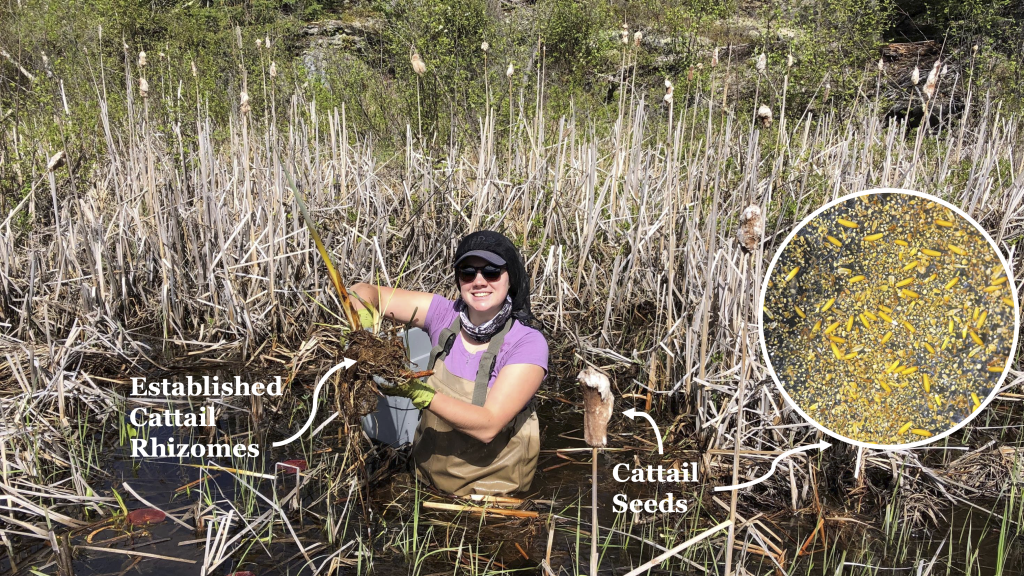
LOWWSF’s communications specialist, Julianna Wanke, has worked for us part-time in 2026 while working toward completion of her Master’s degree, through the IISD-Experimental Lakes Area. Here, she describes her thesis work and research experience.
Cattails and wild rice grow in shallow slow-moving waters of rivers, lakes, and wetlands.
Cattails emerge annually where their root structures, known as rhizomes, are supplied with oxygen, overwintering and growing rapidly in the spring, producing more shoots, expanding laterally with new ramets (shoots that grow from rhizomes) and above ground shoot expansion.
Wild rice grows from seed to maturity in one growing season; the seed overwinters and germinates before emerging each year. As a result, annual seed production helps support future growing seasons.
As cattails emerge and expand, local Indigenous community members have raised the question of whether cattails limit the growth of wild rice?
As an emerging scientist, Julianna’s research through IISD-Experimental Lakes Area (IISD-ELA), was centered around the question of the relationship between cattails and wild rice.
Under the supervision of Dr. Vince Palace, Julianna ran a study at IISD-ELA that looked at how wild rice grows in direct competition with two stages of cattail maturity: seeds and mature (i.e. rhizome stage) under simulated drought conditions.
They found that mature cattails suppress the growth of wild rice. Therefore, to support the growth of wild rice, management of cattail populations is critical before restoration and re-seeding efforts occur.
Really it was much more than a study, going beyond collecting 10,000-plus plant measurements across a 120-day study, looking at the greenhouse gas emissions, and spending countless hours working on data entry into analysis, presentations and thesis writing. Living at IISD-ELA for four months during the study was an incredible experience meeting likeminded freshwater researchers from IISD-ELA, government, other universities, and countries.
Julianna has now completed her studies at the University of Manitoba and in partnership with IISD-ELA. The learning opportunity from science, and life-long friendships from ELA will travel with Julianna wherever her next adventure leads.
You can learn more about IISD-ELA wild rice research in an upcoming Area News Issue.