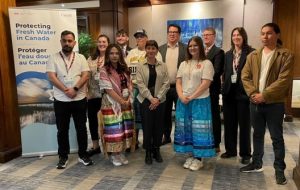
Earlier this summer, Meg was invited to join other emerging water leaders, the President of the Canada Water Agency, and event supporters for a Water Café-style conversation about Canada’s first National Water Security Strategy and what “water security” really means.
Even the word security raised interesting questions. Can water security ever be fully achieved, or is it an ongoing responsibility and shared goal? Water gives and sustains life, but floods, contamination, drought, and other water-related disasters can also cause enormous harm. Clean, reliable water affects everyone, although the impacts are more immediate for people experiencing boil-water advisories, flooding, contamination, failing infrastructure, or water shortages.
Water justice, particularly for northern, remote, and Indigenous communities, was central to the conversation. Participants also discussed:
- Protecting both water quality and quantity;
- Long-term and well-funded water monitoring;
- Nutrient pollution and other freshwater pressures;
- Floods, droughts, wildfires, and climate uncertainty;
- Jurisdictional boundaries that do not follow watersheds;
- Balancing development and environmental protection;
- Collaboration, trust, and relationship-building; and
- Long-term investment and stronger support for remote communities and water-system operators.
The conversation also explored how young people can be meaningfully included in water decisions, not simply invited to listen. Ideas included clearer pathways into the water sector, funded employment and training, mentorship and youth guardian programs, cross-cultural learning, and meaningful places for all ages at decision-making tables. Engagement must also happen directly in communities and include practical supports, such as childcare, that make participation more accessible.
Have your say on Canada’s water future
The Canada Water Agency is now asking people across the country to help shape the strategy. The consultation asks what water security means to Canadians, what challenges and opportunities they see, and which actions the federal government should prioritize.
We encourage everyone to complete the National Water Security Strategy survey by October 25, 2026.
This is an important opportunity to speak up for transboundary watersheds like Rainy–Lake of the Woods, and for long-term monitoring, meaningful Indigenous participation, sustained funding, stronger coordination, and water decisions grounded in community realities.