2020 Watershed Forum – Spotlight on Lake of the Woods Nutrient & Algae Science

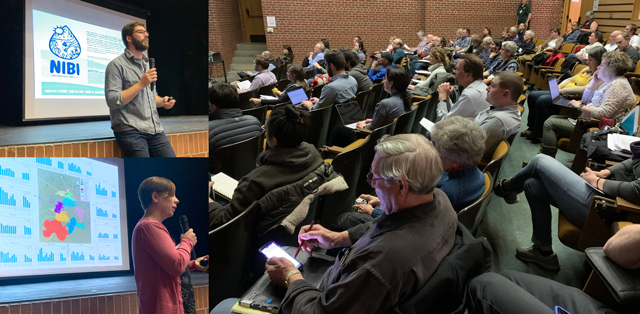 Our annual International Rainy-Lake of the Woods Watershed Forum took place March 11-12 in International Falls, Minnesota. The Forum program featured an update on the Minnesota plan to cut phosphorus, a focus session on toxins produced by algae, a full day devoted to outcomes of Environment Canada’s Lake of the Woods science program and an international panel discussion session on next steps – with science as the foundation, how do Canadian and American agencies move forward to develop a plan for the lake.
2020 Wilson Stewardship Award – Pauline Gerrard
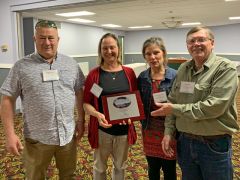
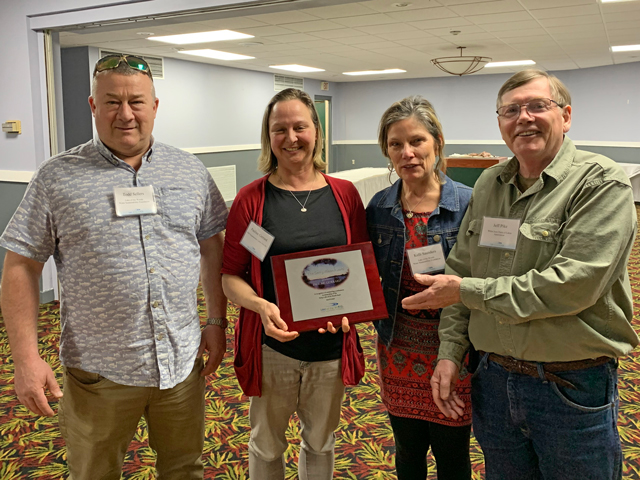 The Foundation presented Pauline Gerrard, Deputy Director of the IISD – Experimental Lakes Area, with the 2020 Wilson Stewardship Award for her leadership in developing environmental education programs at the IISD-ELA and for building knowledge sharing between scientists, First Nations community members and the general public and helping to educate the scientists of tomorrow.
The Foundation presents the Wilson Stewardship Award annually to recognize individuals, groups, or projects that are making significant contributions to environmental stewardship in the Rainy-Lake of the Woods watershed.
2023 Kallemeyn Award – Mike Hirst
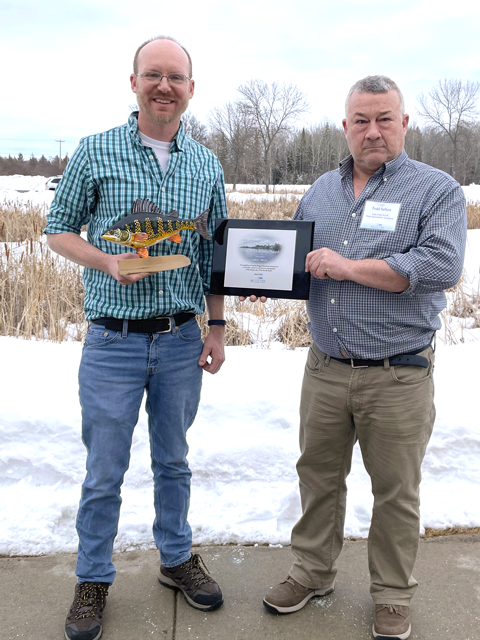
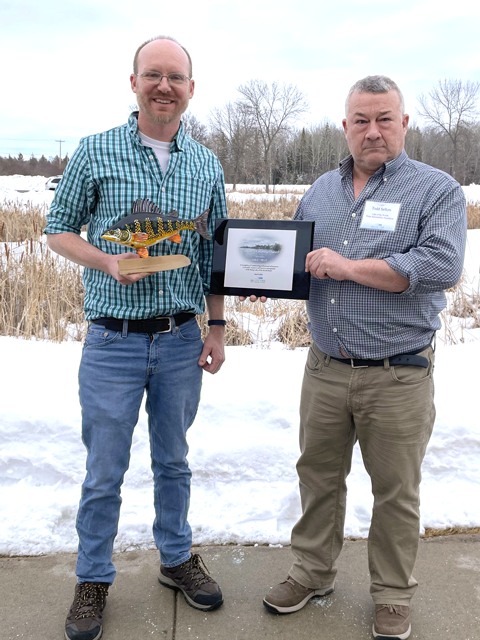 Mike Hirst, Resource Conservationist with the Lake of the Woods Soil and Water Conservation District is the 2023 recipient of the Kallemeyn Award, recognizing his outstanding professional achievements and contributions to collaborative research and resource management in the Rainy-Lake of the Woods Basin.
The Kallemeyn Award was presented to Mike by the Lake of the Woods Water Sustainability Foundation on behalf of the community of scientists and resource managers from the United States and Canada attending the 2023 International Rainy-Lake of the Woods Watershed Forum in International Falls, MN.
2020 Kallemeyn Award – Tim Pascoe
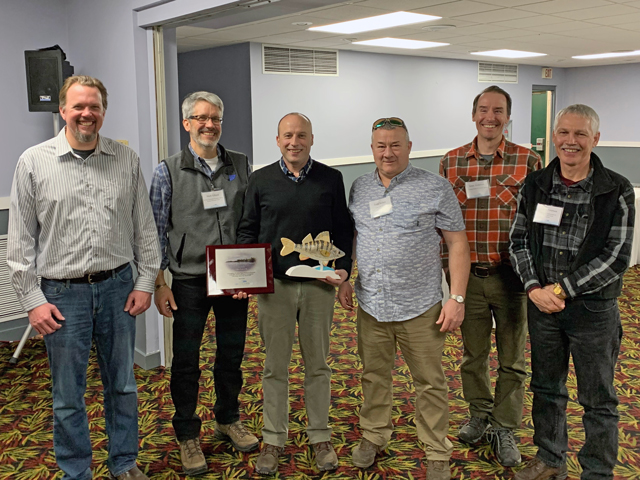
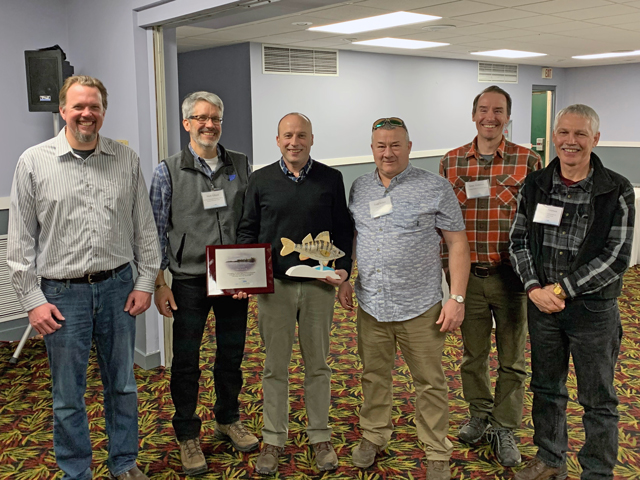 Tim Pascoe, Environmental Scientist with Environment and Climate Change Canada (ECCC) is the 2020 recipient of the Kallemeyn Award, recognizing his outstanding professional achievements and contributions to collaborative research and resource management in the Rainy-Lake of the Woods Basin.
The Kallemeyn Award was presented to Tim by the Lake of the Woods Water Sustainability Foundation on behalf of the community of scientists and resource managers from the United States and Canada attending the 2020 International Rainy-Lake of the Woods Watershed Forum in International Falls, MN.
Deborah Battigelli Memorial Fund Awards Announcement 2023 – Student Support
To honour the memory of Deborah Battigelli, her family established The Deborah Battigelli Memorial Fund at the Lake of the Woods Water Sustainability Foundation. This Fund honours Deborah’s love of life at the lake and her interest to preserve the lake area for future generations to continue to enjoy what she loved. The Fund assists the up-and-coming generation of scientists with their research on our lakes with limited travel support to present their research at the Rainy-Lake of the Woods Watershed Forum. We are pleased to announce that two deserving graduate students will received Deborah Battigelli Memorial Fund awards to present at the Forum in 2023.
{article id=”277″}
[link][title][/link]
[image-intro]
[introtext]
[readmore class=”readmore”]{/article}
{article id=”278″}
[link][title][/link]
[image-intro]
[introtext]
[readmore class=”readmore”]{/article}
Deborah Battigelli Memorial Fund Awards Announcement 2020
{article Battigelli Award – 2020 Recipient Kelly Macgillivray}
[title]
[introtext][readmore text=”Read more…Recipient Kelly Mcgillivray” class=”readmore”]{/article}
{article Battigelli Award – 2020 Recipient Seth McWorter}
[title]
[introtext][readmore text=”Read more…Recipient Seth McWhorter” class=”readmore”]{/article}
Treaty #3 Leadership meet with IJC Commissioners


August 15, 2019 in Treaty 2 Territory, Leadership from the Anishinaabe Nation of Treaty #3 and technical support staff met with International Joint Commission (IJC) Commissioners and staff at Prairie Firehouse in Brandon, MB.
An account of this important meeting as well as details of the Treaty #3 Nibi (water) Declaration is available in the August edition of Treaty 3 News.
EPA Issues New Recommendations for Recreational Water Quality Criteria and Swimming Advisories for Cyanotoxins
Based on the latest scientific information, the U.S. EPA has established recommended water concentrations, at or below which protects public health, for the cyanotoxins microcystins (8 micrograms per liter) and cylindrospermopsin (15 micrograms per liter). EPA’s recommendations are protective of all age groups and are based on peer-reviewed and published science.
Buoyed By New Clues to Lake of the Woods
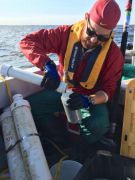
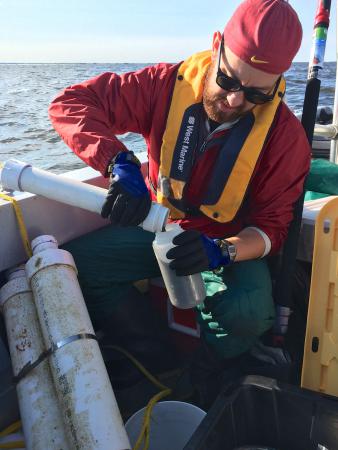 Phosphorus, algae’s favorite food, should be quickly buried by inches of mud year over year. Perhaps, somehow, the phosphorus that had entered the lake during the paper and population booms of the mid-twentieth century is being recycled? Could it be that the turbulent waters of Lake of the Woods south basin (the Big Traverse) are combining with short periods of temperature stratification (when the cold bottom waters of a lake do not mix with the warmer water above) to deplete oxygen and draw nutrients back up from the sediments. Particularly windy days could then mix nutrient rich particles of sediment throughout the water column, allowing pollution from many years ago to be reused over and over again. In this article from the Field Notes – Stories from the St. Croix Watershed Research Station of the Science Museum of Minnesota the story unfolds of research seeking to answer these questions and gain insights into what causes the algae problems plaguing Lake of the Woods.
Studies of Lake of the Woods show how water can struggle with a legacy of pollution
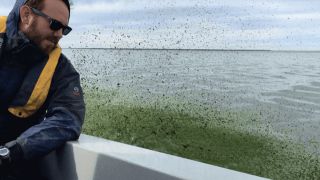
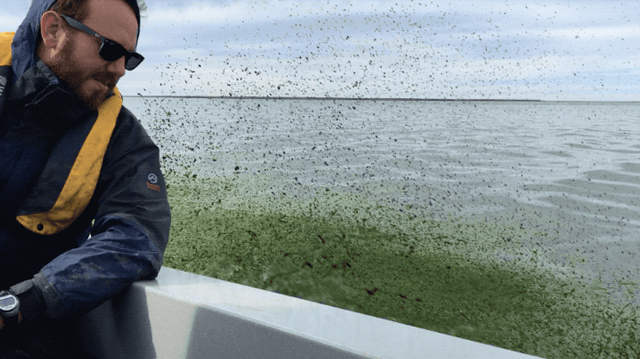 Spanning the U.S.-Canada border at the northern extremity of Minnesota and the northwestern corner of Ontario, vast Lake of the Woods has a storied relationship with humans: as home, as highway, as getaway. Lake of the Woods is well-loved, and troubled. This article from Field Notes -Stories from the St. Croix Watershed Research Station examines the history of pollution and how research studies are improving out understanding the lake’s past and current conditions, including how phosphorus is stored and returned from the lake bottom. These studies are helping us to figure out what forces affect the water quality today — which is essential to setting clean-up goals and identifying the most effective ways to achieve them.