- Details
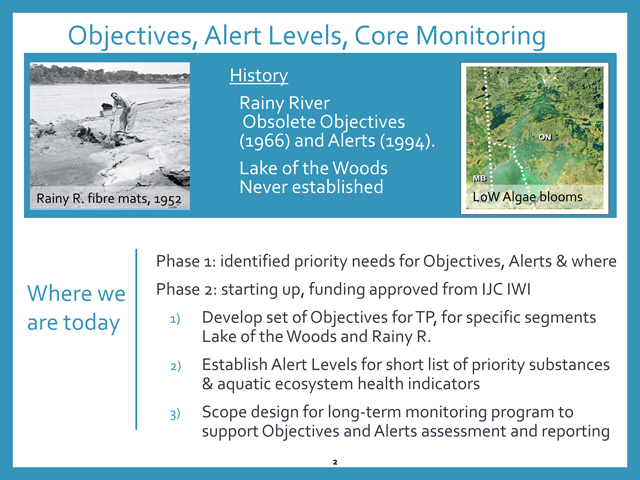 The Lake of the Woods Water Sustainability Foundation plays an essential role in coordinating the network of resource management agencies, government partners, and civil society contributors to watershed science and governance. This year, our coordination has been instrumental in driving forward the second phase of a project to develop recommendations for international water quality Objectives and Alert Levels for the Rainy-Lake of the Woods Watershed. The International Joint Commission has oversight responsibilities for water quality in our watershed, so this project will be administered by the IJC watershed board’s Aquatic Ecosystem Health (AEH) Committee, which is co-chaired by the Foundation Executive Director, Todd Sellers.
Objectives are international standards agreed to by Canadian and U.S. governments for boundary waters. Alert Levels are IJC watershed board-adopted trigger thresholds for advising the IJC and governments of issues of potential concern, where there are no international Objectives established.
- Details
Until international phosphorus objectives are agreed to by governments, the IJC watershed board has adopted an interim approach of reporting on exceedances compared to the most stringent water quality criteria used by local state, provincial, or federal agencies for these shared waters.
The IJC watershed board's Aquatic Ecosystem Health Committee co-chaired by LOWWSF's Todd Sellers, is leading the IJC International Rainy-Lake of the Woods Watershed Board’s current compilation of its annual water quality exceedances report. The report draws on monitoring data provided by federal, state and provincial, and Indigenous agencies and will focus on phosphorus and related algae levels on Lake of the Woods and Rainy River, the principal water quality issues of international concern. Phosphorus is the primary nutrient feeding algae blooms and phosphorus loadings to the lake and its main tributary, the Rainy River, has been the focus of intensive studies by Minnesota and Canada.
The report will also present a summary of exceedances or spills (if any) of the permitted wastewater facilities discharging into the Rainy River and Lake of the Woods.
The report should be completed and submitted to the IJC in late fall – we’ll let you know when it is available and have a summary of findings on the Foundation website.
- Details
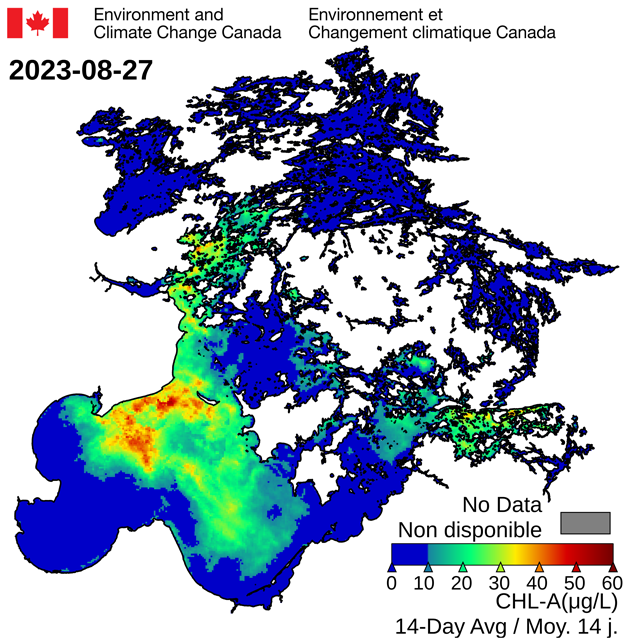 After a hot June but cool and sometimes smoky July, the algae bloom on Lake of the Woods started to develop in late July and early August as usual. Blooms began in the southern Big Traverse Bay and in the Morson-Sabaskong area to the south-east. By late August, the bloom covered 34% of the lake and has progressed northward through middle channel to Oak Point. Satellite-derrived measures of chlorophyll-a (a pigment in the algae) ranged above 40 µg/L (red in the satellite image) indicating severe bloom formation in a few locations (anything above 10 µg/L is considered a bloom).
Algal blooms in Lake of the Woods typically peak in the late fall, and progress into the north-central area of the lake. Thus, more extensive blooms are expected to come later, expanding in extent and severity into the fall. Last year, peak severity occurred on October 13, 2022. We’ll have a complete report on the annual bloom conditions later in the fall, once the satellite tracking is complete for the season.
- Details
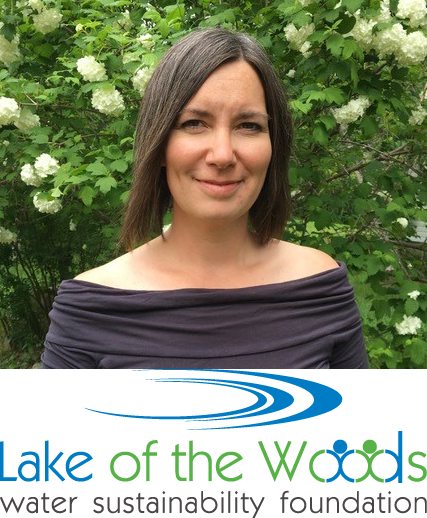 The Lake of the Woods Water Sustainability Foundation is pleased to introduce Teika Newton as the new International Watershed Coordinator.
Teika is a long-time participant in regional watershed science, policy, and governance activities. She has served as a board member for the International Joint Commission’s International Rainy–Lake of the Woods Watershed Board, and co-chaired the Board’s Community Advisory Group, Engagement Committee, and currently the Adaptive Management Committee. Teika also has been helping to guide the IJC Board’s work on climate adaptation since 2016.
With Teika joining our team, the Foundation is doubling down to move projects forward that are central to a sustainability plan, including defining recommendations for international water quality objectives and a multi-nationally coordinated monitoring program, in collaboration with the IJC, Nations, and agencies in the basin.
- Details

Great news! Canada's Budget 2022, released today, includes funding that should help kickstart actions to restore the waters of Lake of the Woods. Specifically as it relates to Lake fo the Woods, Budget 2022 proposes:
- $43.5 million over five years, starting in 2022, to Environment and Climate Change Canada (ECCC) to create the new Canada Water Agency, which is to have a madate for the large rivers and lakes in Canada such Lake of the Woods.
- $19.6 million in 2022-23 to ECCC to a Freshwater Action Plan (the future after 2023 of this initiative will be announced later) -- This funding will support clean up efforts in our major waters - specifically including Lake of the Woods, along with the Great Lakes, the St. Lawrence River, Lake Winnipeg, the Fraser River, the Saint John River, the Mackenzie River, and Lake Simcoe.
In 2019, the Canadian government committed to establish a federal Canada Water Agency to work with provinces, territories, Indigenous communities, and other stakeholders in order to find the best ways to keep Canada’s water safe, clean, and well-managed. Budget 2022, committs that the CWA will be up an running this year (2022). We expect that this will move our objectives of developing an plan for Lake of the Woods forward, with phosphorus pollution reduction targets to address toxic algae in the lake.
- Details
By Bev Clark, for the Lake of the Woods Water Sustainability Foundation
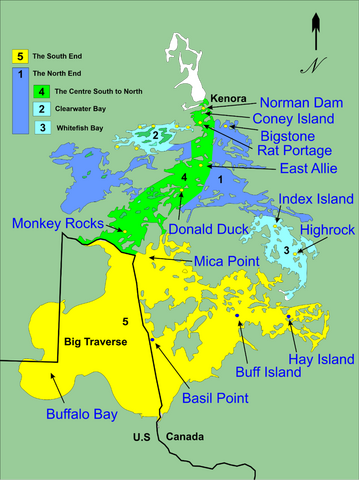 In this article, Bev Clark, takes a look at the tremendous variation in total phosphorus (TP), as a measure of water quality, across the vast expanse and five distinctly different areas of Lake of the Woods. Phosphorus is the primary nutrient that supports the growth of algae, and in excess can lead to sever blooms, widespread across much of the lake. Bev graphically presents average and ranges in TP for each lake area and discusses reasons for the diffenences and relatioship to the risks of developing algae blooms.
Bev Clark is one of the co-editors of the recently-released 2022 Rainy-Lake of the Woods State of the Basin Report, and this article summarizes a small aspect of the information from it.
- Details
Heartfelt thank you to a true Lake of the Woods ambassador, Art McKenzie
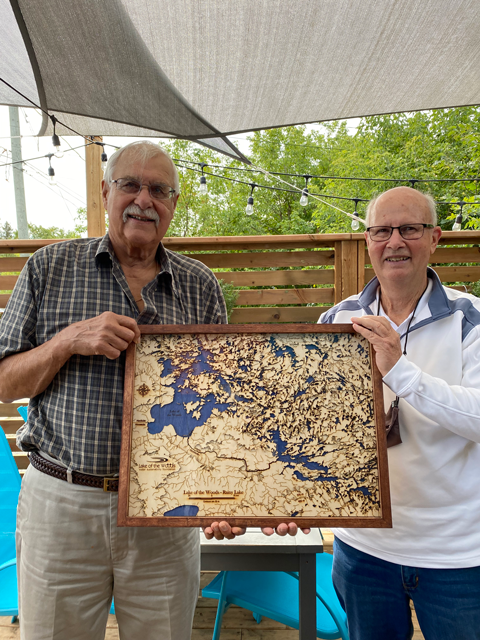 A huge “thank you” to Art McKenzie for his decades of volunteer service to Lake of the Woods, as a founding Director and Treasurer of the Lake of the Woods Water Sustainability Foundation, and before then, a long time Director and President of the Lake of the Woods District Stewardship Association.
Last fall, LOWWSF Directors met with Art to thank him in person — a ceremony delayed by COVID restrictions since Art’s retirement from the Foundation Board in June 2020. Tony Stephens, President of the Foundation, presented Art with a retirement gift honouring his contribution to our international lake and its watershed – a wood-cut map of the entire Lake of the Woods watershed.
From all of us at LOWWSF, a giant “thank you” to Art and best wishes for life in retirement at the lake!
- Details
 The Proceedings Report of the 2023 International Rainy-Lake of the Woods Watershed Forum is available for download at the Foundation’s website: lowwsf.com/forum-proceedings. Held March 8-9 in International Falls Minnesota, 132 researchers, resource managers, policy makers, and members of the public put Lake of the Woods and its watershed under the microscope.
The report covers a wide range of subjects – Many of the 25 presentations this year focused on knowledge and tools that will inform management actions. The schedule was full, with research presentations split among six sessions covering a wide range of disciplines including: water quality management and monitoring, watershed management, nutrients and algal blooms and toxins, and emergent technologies for remote sensing and monitoring.
Please
pdf
download a copy of the report now.(9.19 MB)